CPR Basics Every Adult Should Know
Cardiac arrest can happen anywhere — at home, at work, on a hiking trail, or in a grocery store aisle. It does not wait for paramedics to arrive. In those first critical minutes, the person next to the victim is often the only one who can keep blood flowing to the brain and vital organs. That person might be you.
Cardiopulmonary resuscitation, or CPR, is not reserved for healthcare professionals. It is a practical skill that any adult can learn and perform. You do not need medical training to push hard and fast on someone's chest. What you need is a clear understanding of what to do, in what order, and why each step matters. This guide covers the essentials every adult should know before an emergency strikes.
Understanding the Chain of Survival
CPR does not exist in isolation. It is one link in a sequence called the chain of survival, a framework developed by the American Heart Association that describes the steps most likely to save someone experiencing sudden cardiac arrest. When every link is strong, survival rates improve dramatically.
The chain of survival includes five interconnected steps:
- Recognition and activation of the emergency response system — Someone recognizes that the person is in cardiac arrest and immediately calls 911 (or your local emergency number).
- Early CPR — A bystander begins chest compressions to maintain blood circulation until professional help arrives.
- Rapid defibrillation — An automated external defibrillator (AED) is used to restore a normal heart rhythm if the arrest is caused by a shockable rhythm.
- Advanced life support — Paramedics and emergency medical personnel provide medications, airway management, and other advanced interventions.
- Post-cardiac arrest care — Hospital teams manage the patient's recovery, including targeted temperature management and coronary intervention when needed.
As a bystander, you are responsible for links one and two — and often link three if an AED is nearby. You cannot control when the ambulance arrives, but you can absolutely control whether compressions start within the first minute. That is where survival is won or lost.
Step 1: Check for Responsiveness
Before you begin CPR, you must confirm that the person actually needs it. CPR is performed on someone who is unresponsive and not breathing normally — not on someone who is merely unconscious but breathing steadily, and not on someone who is awake and talking.
Approach the person safely and tap firmly on their shoulder while shouting, "Are you okay?" Look at their chest for movement. Listen and feel for breathing at the mouth and nose. Agonal gasps — irregular, snoring-like breaths that occur during cardiac arrest — are not normal breathing. If you are unsure, treat it as cardiac arrest and act.
If the person responds, stays awake, or breathes normally, CPR is not needed. Monitor them closely and be prepared to call for help if their condition worsens. If they do not respond and are not breathing normally, move immediately to the next steps.
Step 2: Call 911 and Get an AED
Time is the enemy in cardiac arrest. Brain damage can begin within four to six minutes without oxygenated blood flow. Call 911 immediately — or direct someone specific nearby to call while you begin compressions. Saying "Someone call 911!" to a crowd often results in nobody calling. Point to one person and say, "You in the red shirt — call 911 and tell them we have an unresponsive person not breathing. Come back and let me know help is on the way."
If an AED is available, send someone to retrieve it right away. AEDs are increasingly found in workplaces, gyms, schools, airports, and public buildings. The device will guide you through pad placement and shock delivery with voice prompts. Starting CPR while waiting for the AED is exactly the right approach.
Step 3: Chest Compressions — The Core of CPR
Chest compressions are the single most important intervention a bystander can provide. Even imperfect compressions are vastly better than no compressions at all. Here is what high-quality compressions look like:
Hand Position
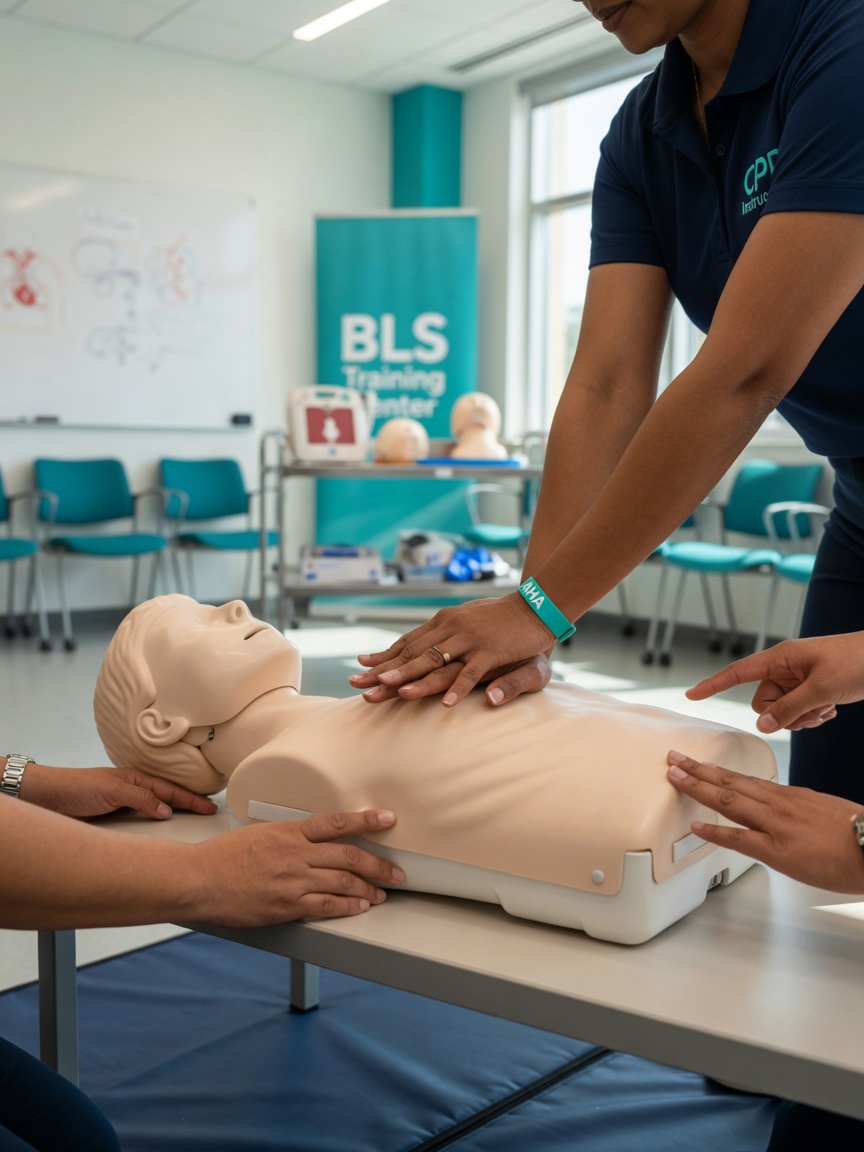
Place the heel of one hand on the centre of the chest, on the lower half of the breastbone (sternum). Place your other hand on top, interlacing your fingers. Keep your arms straight and position your shoulders directly over your hands.
Compression Depth
Push hard enough to compress the chest at least 5 centimetres (2 inches) for an adult. Do not be afraid to push firmly — you are pumping blood through the body. If you are not compressing deeply enough, the heart cannot generate meaningful circulation.
Compression Rate
Deliver compressions at a rate of 100 to 120 per minute. A helpful way to maintain rhythm is to push to the beat of the song "Stayin' Alive" by the Bee Gees, which clocks in at roughly 103 beats per minute. Count out loud if it helps you stay on pace.
Full Recoil
After each compression, allow the chest to return fully to its starting position. Do not lean on the chest between compressions. Full recoil allows the heart to refill with blood, which is essential for effective pumping on the next compression.
Minimize Interruptions
Every pause in compressions reduces blood flow to the brain. Limit interruptions to less than 10 seconds whenever possible. If you need to use an AED, resume compressions immediately after the shock is delivered (or if no shock is advised), without waiting for the AED to prompt you.
Hands-Only CPR: When It's the Right Choice
For adults and teens who suddenly collapse and are unresponsive, hands-only CPR — continuous chest compressions without rescue breaths — is recommended for untrained bystanders and is highly effective. The chest compressions alone circulate residual oxygen already present in the blood, and they eliminate the hesitation many people feel about mouth-to-mouth contact.
Research consistently shows that bystander hands-only CPR doubles or triples survival rates compared to waiting for EMS without any intervention. If you witness an adult collapse and you are unwilling or unable to give rescue breaths, push hard and fast in the center of the chest without stopping until help arrives or an AED is ready.
When to Use Rescue Breaths
Rescue breaths are still important in specific situations. The American Heart Association recommends conventional CPR (30 compressions followed by 2 rescue breaths) for:
- Children and infants — Pediatric cardiac arrest is more often caused by respiratory problems, so oxygen delivery through breaths is critical.
- Drowning victims — The primary problem is lack of oxygen, making rescue breaths essential from the start.
- Drug overdose — Respiratory depression is common, and breaths address the root cause.
- Unwitnessed collapse — When you do not know how long the person has been down, they may already be oxygen-deprived.
- Trained responders — If you are trained and comfortable giving breaths, conventional CPR may provide additional benefit for adults.
To give a rescue breath, tilt the head back, lift the chin to open the airway, pinch the nose shut, and create a complete seal over the person's mouth with yours. Give a breath lasting about one second, just enough to see the chest rise. Give a second breath, then resume compressions immediately.
Common CPR Mistakes to Avoid
Even well-intentioned rescuers make errors that reduce the effectiveness of CPR. Watch out for these frequent mistakes:
- Compressing too slowly or too shallowly — Light, slow compressions do not generate adequate blood flow. Commit to depth and speed.
- Leaning on the chest — Failing to allow full chest recoil between compressions dramatically reduces perfusion pressure.
- Stopping compressions too long — Checking for breathing, waiting for the AED, or switching rescuers should take seconds, not minutes.
- Incorrect hand placement — Compressing too high on the sternum or off to one side is less effective and can cause injury.
- Not calling 911 first — Starting CPR without activating emergency services means help may arrive too late even if your compressions are perfect.
- Giving up too soon — Continue CPR until EMS takes over, an AED is ready and analyzed, you are physically unable to continue, or the scene becomes unsafe.
- Performing CPR on someone who does not need it — Always check responsiveness and breathing first. CPR on a breathing person is unnecessary and potentially harmful.
Your Confidence Matters
The biggest barrier to bystander CPR is not lack of knowledge — it is fear. Fear of doing it wrong, fear of hurting the person, fear of legal consequences. Good Samaritan laws in Canada and the United States protect people who provide reasonable emergency aid in good faith. A cracked rib is a sign that you were pushing hard enough, not a reason to stop.
Reading about CPR is a strong first step. Practicing on a manikin with real-time feedback is what builds the muscle memory and confidence to act when adrenaline is surging and every second counts. The person on the ground cannot wait for you to feel ready. They need you to start now.